
How Data Governance Is Activated
Activating the Data Governance Triad


From data governance design to data governance activation
Data governance is often discussed in terms of frameworks, operating models, and organizational structures. In practice, however, the challenge is rarely the absence of a model. It is the difficulty of making data governance work on a daily basis within organizations that are distributed, autonomous, and continuously changing.
On a high-level, we need to understand data governance not a function to be staffed, but as a set of enduring responsibilities that must be fulfilled within a socio-technical system. These responsibilities form what we refer to as the Data Governance Triad.
The Data Governance Triad consists of three roles:
Data Negotiation, which aligns requirements and meaning
Data Direction, which provides strategic intent and constraints
Data Accountability (Audit), which assures that intent and agreements hold over time
When viewed through the lens of the Data Governance Triad, an important connection becomes clear: Data governance is not a technical add-on to the organization, nor a specialized discipline concerned only with governing data quality, metadata, or platforms. It is an extension of how organizations govern themselves.
Knowing these roles is necessary, but not sufficient. The practical question for data leaders and practitioners is how these roles are activated in reality, not as a project, not as a maturity stage, but as continuous capabilities embedded in how the organization operates.
The structural need for the Data Governance Triad
Before we can dive into this, we must first acknowledged foundational constraint: No single actor sees the whole system, and no single mechanism can govern it.
Modern organizations consist of multiple domains, teams, platforms, and increasingly autonomous systems. Each has its own objectives, constraints, and interpretations. Data flows between them, but that does not mean that meaning and accountability propagate automatically. Quite the contrary.
This is precisely why the Data Governance Triad exists.
Data Negotiation exists because agreement on meaning and requirements is not given. Definitions, quality expectations, and usage assumptions are constantly challenged, implicit, or locally optimized.
Data Direction exists because strategy does not execute itself. Think about principles without explicit choices that leave room for contradictory decisions to coexist and prosper.
Data Audit exists because accountability does not naturally follow data as it moves across organizational and technical boundaries.
Together, the three roles ensure that autonomous behavior remains aligned with organizational intent, even when complexity is so high that no one can control the system as a whole. We will double down on the three roles in a later article.
From roles to practice: the activation challenge
Understanding the Data Governance Triad conceptually is only the first step. The real challenge for data leaders is activating these roles without necessarily turning data governance into a centralized control function.
Each role must operate under the same structural constraint: partial visibility. Data governance cannot assume that documentation reflects reality, or that stated intent governs behavior. We need to realize that informal practices, work arounds, compensating mechanisms, and local interpretations often have more influence on how data is actually used.
This constraint leads to a shared operating logic that applies to all three roles.
The activation pattern: Orient, Surface, Produce, Feed
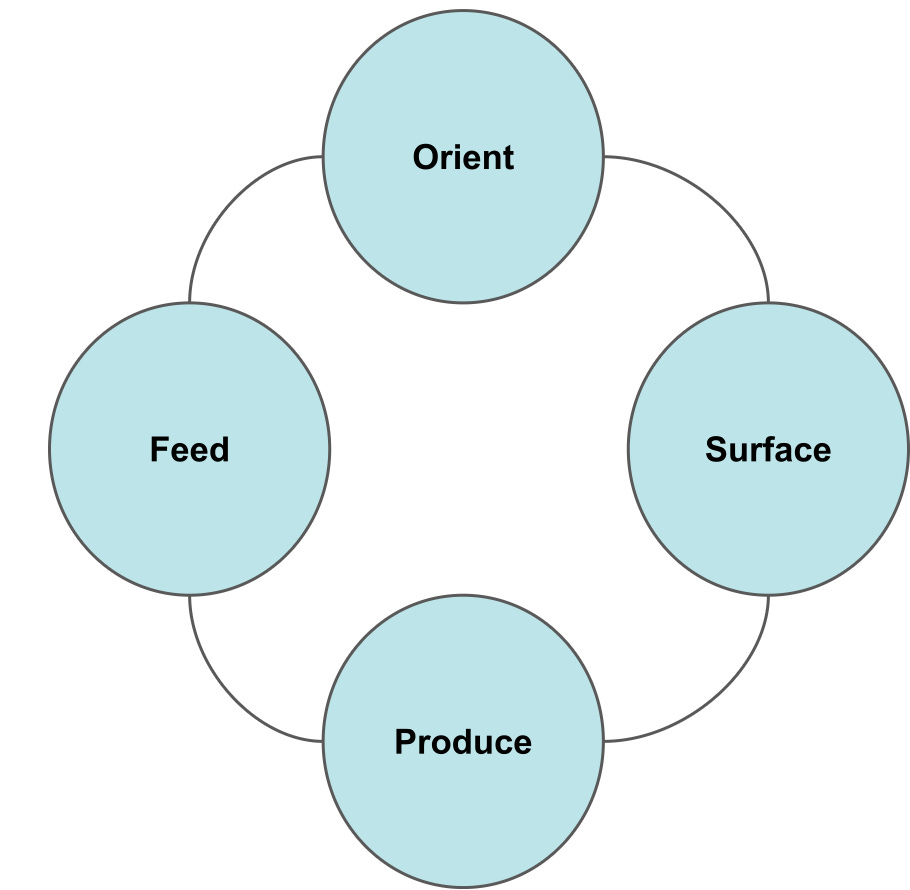
Across the Data Governance Triad, data governance activates through the same four phases: orient, surface, produce, and feed (OSPF).
Do not think of this pattern as a methodology or a maturity model. It is the minimum sequence of activities required for data governance to operate meaningfully within the complexity pf distributed data landscapes, autonomy, and AI environments.
Each role in the Data Governance Triad activates this pattern differently, but the logic remains the same.
Orient: Seeing the system as it is
The orient phase exists because data governance cannot act on assumptions. Orientation is about understanding the system as it actually operates. It often starts with a clear mapping of your environment, and a review of existing data models and policies. But it goes beyond what is described in documents or diagrams.
For Data Negotiation, orienting means identifying who produces, consumes, and depends on data, and distinguishing between formal requirements, informal expectations, and unspoken assumptions. That requires a understanding of the business needs, the regulatory requirements, the market context, and the existing technology constraints.
For Data Direction, orienting means mapping the strategic landscape: which principles and capabilities exist, how is the context analyzed, which decisions have been made, and which choices have been deferred or left ambiguous.
For Data Audit, orienting means understanding where data flows cross boundaries, how accountability is placed, where contracts and controls exist, and where observability is missing.
Orientation endures the right focus.
Surface: Making misalignment explicit
Many data governance issues persist because they remain invisible. Divergent definitions coexist because no one has exposed them. Ambiguous principles persist because specificity creates tension. Ungoverned data flows persist because monitoring has never been implemented.
The surface phase exposes what the organization is currently (knowing or unknowingly) compensating for.
Data Negotiation surfaces divergent meanings and conflicting expectations.
Data Direction surfaces uncommitted strategy, principles that sound decisive but do not constrain behavior.
Data Audit needs to surface ungoverned or poorly governed practice, such as data flows without contracts or agreements without monitoring.
This phase is often uncomfortable, because surfacing ambiguity creates friction. But data governance that avoids surfacing is documenting rather than governing.
Produce: Creating artifacts that change behavior
Data governance becomes effective only when it produces artifacts data management can act on. Just creating insight without a concrete, actionable outcome does not change behavior.
Each role in the Data Governance Triad produces a distinct type of artifact:
Data Negotiation produces agreements: documented resolutions to contested requirements with clear ownership and measurable terms. These can be translated into polices, procedures, data requirements, or data models.
Data Direction produces choices: explicit strategic decisions that close ambiguity and create constraints for local optimization. This is what data strategy is about: navigating uncertainty.
Data Audit produces evidence: structured assessments that show whether agreements hold and choices are followed. This can happen through assurance loops or data contracts.
Although different in form, these artifacts share an essential property. They are concrete enough to act on, specific enough to measure, and documented enough to be examined and refined continuously.
Feed: Turning data governance into a continuous capability
Governance becomes real when the created outcome and artifacts are not isolated, but can work together, feed into each other. The feed phase ensures that outputs from one role become inputs for the others.
Negotiated agreements become targets for audit and candidates for strategic scaling. Strategic choices create new negotiation work and define what audit must verify. Assurance evidence feeds back into both Data Negotiation and Data Direction, triggering renegotiation or strategic adjustment when patterns of misalignment emerge.
The three roles of the Data Governance Triad do not operate sequentially. They operate in parallel, feeding one another continuously. This is why they cannot be hired as discrete positions. They are roles data governance must play across the socio-technical system.
What this means for data leaders and practitioners
For data leaders, the activation pattern has clear practical implications: data governance should start where friction is highest, because the absence of a role will reveal itself through actual pain: conflicting definitions, strategic paralysis, or lack of trust in data.
Data governance earns credibility by producing one tangible artifact before expanding scope.
Data governance only becomes durable once the cycle has turned at least once, with artifacts produced by one role being consumed by the others.
The pattern does not prescribe tools, timelines, or organizational design. These are dependent own implementation, and vary across organizations and time. What remains stable is how data governance must operate under complexity.
Conclusion: activating the Data Governance Triad
This is the reframing that I push for: effective data governance is not implemented. It is activated.
Data governance applies the principles of corporate governance—direction, oversight, and accountability—to a socio-technical system for data in which humans and machines jointly shape outcomes. It ensures that as autonomy increases and execution is delegated to systems, organizational intent remains effective and accountability remains intact.
This is why I define data governance as a human-based system by which data assets in a socio-technical system are directed, overseen, and by which the organization is held accountable for achieving its defined purpose. The emphasis on “human-based” is deliberate. Processes, platforms, and automation are essential to execute governance decisions consistently at scale, but they do not define purpose, nor do they carry responsibility for consequences. Governance itself remains a human responsibility.
Activating the Data Governance Triad (Data Negotiation, Data Direction, and Data Audit) is therefore not about managing data better in isolation. It is about maintaining accountability in a digital, distributed world where decisions are increasingly mediated by data and executed by machines.
For data leaders and practitioners, this reframes how we think of data governance: Activating data governance is not about implementing a framework. It is about ensuring that the organization continues to govern itself coherently as its socio-technical reality evolves.
I like this approach (could discuss aspects of it). I believe more and more that after federating data platforms, data catalogues and other data-enabling or data-driven processes and applications, we should look into federating data governance as well with local ‘champions’ rooting for it. Your proposed roles and phases might just enable that.